Sunday, April 4, 2010

100 Degrees in the Shade

It is unseasonably warm in Virginia -about 20 degrees above the norm for this time of year. This means it is 120 degrees in the greenhouse, and even the tropical water plants are wilting.

This calls for some sort of shading on the southern side. The first summer we built the greenhouse, I planted mammoth sunflowers on either side, thinking it would be a low cost alternative for shade, as well as a food source for the birds. The sunflowers were beautiful, but weren't thick enough to block any degree of sunlight.

The two following years I simply moved plants out when it became too hot inside, and sacrificed the use of the greenhouse for the summer months.

This year, I really want to see how long I can stretch out the growth season for both lettuce and spinach (both cool weather crops).

So this year I purchased a 60% shade cloth. This means the weave blocks 60% of the sunight and UV rays. Not only will it keep the temperatures down, but it will protect the outside wood a little more from the sunlight. The one I chose is black, but they also come in white, green, and tan, in a cariet of sizes. (Source: CatalogClearance) Order a larger size than you think you'll need, particularily if your greenhouse has a gable roof. Voice of experience here.


The shade cloth comes with both finished edges and grommets. Ours is anchored at the bottom with a 12' length of 1" PVC pipe. We drilled holes to match the grommet spacing, then ran zipties through the pipe, and then securely through the grommets. The PVC pipe is then attached to eyehooks on the greenhouse. This anchors it on windy days.

The other end is attached the same way to another length of PVC pipe and then secured to the roof line and anchored to eye hooks.


Inside, the temperature has already started dropping from 120 down to 100 degrees, and the light is softer with the heat filtered out.


By the end of the day the temperature has dropped to 80 degrees.


This morning the lettuce was crisp and literally a brighter, deeper shade of green.


The oregano seedlings have started sprouting.


And the pot of oregano literally exploded.


The comfrey added an inch or two, and the leaves are more alert with variations of green.

On the whole, everything just seems to prefer the filtered light, and the warm, but not searing hot temps.

Even the water plants have greened-up. They are probably anxious to get back in the outdoor pond. Hopefully, that will be ready next weekend.
Meanwhile in the outside garden:

Horseradish is back with a vengeance. I use it as an insect deterrant, but it can be easily harvested to make horseradish (just grate the root). But be warned that this is a plant that is almost impossible to get rid of - every piece of root will sprout a new plant. I happen to like it, and don't mind it spreading.

The peas planted in bales a week or so ago are sprouting now, thanks to everyday watering to get them established.

Today we had to mow for the first time this year, and cut down some wild paradise trees that seem to pop up everywhere. Next weekend is the rain barrel system!

Thursday, March 25, 2010

Tote That Bale and Hose...and Coathanger

Yes, coathanger.

Specifically the wire ones that DH gets with his drycleaning. The rest of the family likes plastic hangers, meaning there are TONS of these accumulating.

So what better use for them than out in the garden?


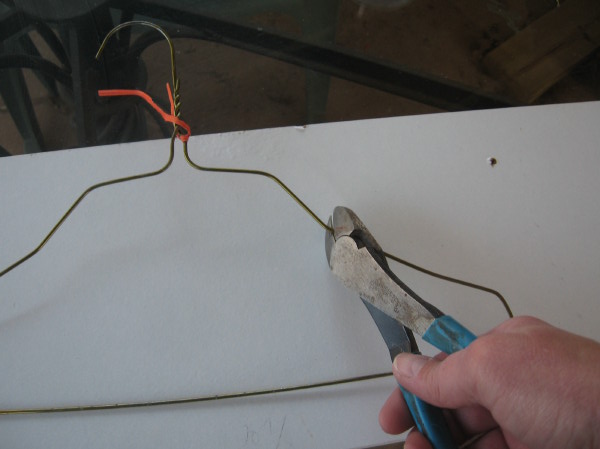
These are dykes.

No, not that kind.

The kind used to cut metal or wire........like wire coathangers.


Cut each side of the hanger at the shoulders.


Then cut the long bottom side exactly in half.


Leaving this. (Toss the hook part unless you have another creative use for it).


Here's the two ends, looking suspiciously like stakes, perfectly designed for holding down drip hose in any sort of garden: raised bed, tilled earth, lasagna or........wait for it.............straw bale!


One can never have too many stakes for hose.


And here they are serving their new purpose - just push them down over your hose every 2 feet or so.


Keeping staking those miles of drip hose, using T-connectors where necessary, and caps at the endpoints.

I love drip hose. To use the straight or T-connectors, just push the hose into the connector. Drip hose lasts season after season and can be re-configured every year when I change my mind as to which way my garden is laid out. At the end of the gardening season, I watch the stores and buy up whatever hose and connectors are put on sale, stashing it away till the next spring.


The yellow hose leading towards the camera is the main hose that connects to the yard spigot.

The eventual goal is to have a water barrel here in the corner of this end of the garden, but I'm not entirely sure that it will have enough water pressure to push water through the permeable drip hose. Either way, the spigot water remains a backup, with the water barrel being a main source for water buckets.


All that hose laid out and staked with the wirehanger stakes. Yes you can purchase "garden stakes" if you need them, but why spend your hardearned money if you have wire hangers around the house? They work for staking hose, black plastic, clear plastic tunnels for starting plants early, the list is endless.


Occasionally when the drip hoses are first connected and turned on, there are geysers in unexpected places (that's what that odd brown root is marking). Then the water is turned off and that section of hose is cut and a connector put in. Or sometimes it's mended with duct tape. Depending on what I have available. Duct tape works, but is not the most aesthetically pleasing.


If you're planting a straw bale garden, and have laid and staked your drip hose, the next step is to spread a layer of soil over the drip hose.


This afternoon I had enough garden dirt (not potting soil) to layer over the first U shape of the bales. This early in the spring, this is all I need to prepare at this time. On the left arm of the U will be the melting sugar snap peas; along the back of the U spinach will be planted, and on the right hand side of the U, cauliflower.


The peas (and later the beans) will do much better (no matter where they are planted) if this Granular Garden Soil Inoculant is used. After reading about it (and reading it was available in any garden supply store, which it wasn't) I eventually had to order it online from Planet Natural.

It's easy to apply and non-toxic. Make a furrow in the dirt, add the seed, then sprinkle in the inoculant. The can above is enough for 150 linear feet (cost is $8.95 plus shipping). No danger of an overdose - the legume roots love it. The idea behind it is that the bacteria (that's what it is -bacteria) clings to the plant roots, and pulls nitrogen out of the soil/air/straw/planting medium and making the roots thick and healthy.


Then comes the fun part: writing the name on the little copper sign. I love these old-fashioned copper markers, and I pick them up at Target every year, in that $1 section at the front of the store.


What I planted today: Melting Sugar Snap Peas, Cauliflower, and Spinach. All cold weather crops that will love to have the occasional chilly evening, and then the hot sunny afternoons.

And if there should be a late frost or light snow, they'll be okay with that too.

I won't, but they will.
Disclaimer: No coathanger manufacturer has supplied me with coat hangers free of charge, and all Planet Natural did was accept my order and ship it to me for their customary charge. I can't remember the last time I got anything free. Definitely not the packets of seeds. Paid full price for them. Sure hope they grow.

Friday, March 19, 2010

Bales Upon Bales Upon Bales

Picked up 10 more bales today to line the side of the garage (that IS NOT a black snake, it's the soaker hose for that area).....


Also grabbed another bag of soil - this will be laid out on top of the bales, and the cucumber seeds planted there. Then watered every day, or every other day with the soaker hose. One day in June, the cucumber vines will be all leafy and green, and they will hide the soaker hose, and inevitably I will forget about it, then catch a glimpse, shriek, and kill the soaker hose with my hoe.


I promise you this will happen.

The daylilies are back at the spigot.


I had three extra bales after finishing off the garage bed, so they were added to the yard. These bails will get soil, seeds or plants, and soaker hose as well.


Something in the greenhouse is eating the tops off my broccoli and cauliflower. But only in those two tubs. the other blats and pots are left untouched.


Comfrey is back! I think I'm going to add some more plants -I love the way I can use it for mulch and making fertilizer water, and, of course, comfrey salve.

Tomorrow is repair day for one of the faucets that froze and broke, plus starting to get the pond water system thought out.

Monday, March 15, 2010

Romaine and Bales

Sounds like a law firm....

I rearranged the straw bales again, just in time to catch a huge rainstorm that began wetting them down. I'm thinking I can plant a few big container tubs and set them in the open area, or/and arrange gourd plants (they always cooperate and cover large amounts of area).

I've been in search of the elusive legume inoculant that I need to sprinkle on the bales before planting peas or beans. Having no luck locally, I ordered it online from Planet Natural. I haven't used them before, so no recommendation yet. I did notice they have quite a few hydroponic supplies, and that's something else I've been wanting to try.

While at the feed store looking for inoculant, I found 9-packs of romaine lettuce and picked up a couple.

Twelve romaine plants went here, in big tubs, then covered with an old cotton curtain panel to keep out bunnies. It also filters the light and lets the rain come through.


They'll look better after they recouperate from transplanting.


The remaining 6 plants were planted in the greenhouse - just stuck in wherever there was room.


Meanwhile the romaine planted from seed is finally popping up.


Also ordered a 60% shade cloth this weekend for the greenhouse -with its help, I'm hoping to grow lettuce and spinach all summer.


Hope springs eternal.

Saturday, March 13, 2010

Straw Bales R Us

The experiment begins.....


Today we brought home 18 straw bales, in two loads, and could easily use 18 more, but I'm baled out for the day.

The trick is to place them where you want them. Never plan on moving them 1) after they are wet at all; and 2) after they are planted. The first will break your back and the second will break your plants.

First I wasn't sure if they are meant to be planted sitting with the raw side up, or the flat compacted side. Ended up going with the flat compacted side. 50-50 chance that's wrong -I'll let you know.

Then I couldn't decide how to arrange them. Started with a long line, like outside walls. then realized the drip hose has to run along the top, and it would be more efficient not to have walk-through breaks. So currently they are set serpentine style. This may change.

Started looking for legume inoculant, which is harder to say outloud than you would think. i want to plant peas and beans in some of these bales, and the inoculant is a bacteria that gets sprinkled on the top to help the root systems convert nitrogen in oxygen into nitrogen for their roots. Kindof like making it out of thin air. This will eliminate the need for additional fertilizer.

Found it online, but am going to try one more local place on Monday to save the shipping cost if possible.

Also got the remainder of the plastic down - this will be a pepper bed I think - it's the lower side of the blueberry patch. Peppers love black plastic and the warmth it gives their roots.


Also got the plastic down next to the garage bed. Somehow I forgot to get the straw bales for this area. For the last several years, whatever I plant here (cukes, cauliflower, broccoli) have been eatten alive. Only in this bed though, making me think it's some insect that winters over in the soil, then pops up to find I've planted it a smorgasbord breakfast. Like the big garden, this small patch can bake over the summer, and kill whatever lives there. Meanwhile the straw bales will grow cukes galore.

A few volunteer onions are up -this bed needs revitalizing this year. I may just do plastic here and bales too -it's cool and shady even at the height of summer -might be a great place for lettuce.

Speaking of lettuce, I also ordered the shade cloth for the greenhouse this afternoon. It's cloudy, and low 60's today, but it's 100 degrees in the greenhouse. The shade cloth coming is 60% black woven meaning it should cut 60% of the UV and sun, so I can continue growing some crops in the greenhouse this summer.

The pot of comfrey is coming up. I want to plant a bed of this somewhere in the yard this year -this plant lasted until January, and provided leaves for the water bucket. Comfrey leaves in water makes a great fertilizer, plus it's a prime ingredient for comfrey salve.


The cauliflower plants are almost ready to set out.


In back of the cauliflower, the Sicilian Marjoram is coming back. I've decided to plant large amounts of marjoram, basil, oregano and sage this year to mix my own Italian seasoning.


My poor sad spinach seedlings. I seem to be incapable of growing this. Maybe if I buy larger plants....


Lettuce taking it's leisurely time to get big enough to eat. We may starve before this is large enough.


And of course there's still the whole rain barrel system to tweak this year, and the pond to add to the mix, and the drip hoses to lay......


Plus the more I look at those photos of the straw bales, the more I think I'm going to rearrange them. Perhaps a T-design.