Showing posts with label Straw Bale Gardening. Show all posts

Wednesday, July 14, 2010

In the Midnight Garden of Nothin' Growin'


What do you do when your garden is a complete and abject totally dismal failure?

You harvest the only two things growing: cherry tomatoes and armloads of mint.

And beg your parents for fresh veggies.

And, instead of wasting water on the sad, sad remains of wasted delinquent plants - you regroup and start planning the fall garden, which will lay the groundwork for the garden next spring.

A quick rehash: my normal garden site was inundated with the Evil Wiregrass. This spring, that site was covered with black plastic to bake out the said Evil. Meanwhile I decided to try straw bale gardening as a temporary solution.

The good news: none of the plants in the straw bales has been eaten by the various bunnies, deer, groundhogs, or neighborhood dogs.

The bad news: it's because the plants are either dying or dead, and not even the groundhogs will touch them.

There comes a time when every gardener should be smart enough to throw in the trowel, and give it up. This would be that time for me.

Straw bale gardening works for a lot of people. Didn't work for me.

Global warming works for a lot of people. Isn't working for me. What should be a May/June growing season has accelerated into a late April/May growing season, followed by two months of searing hot temps. Spare me the "global warming is a myth" emails - I am permanently entrenched in the camp of your opposition, having seen the evidence for my own eyes, for more than a few years.

Even the mint is two months ahead of itself, which considering the lack of rain, is pretty much unexplainable.

The one bright spot is that the cherry tomatoes are all container grown, and are as sweet as they can be.

What's coming out of all this is a decision to cut back on the backyard garden next year and pull the veggies in close to the house, in containers. The big growing space out back is going to be replanted with large herb beds - plants that do well in heat without extra watering (herb is simply code for "weed" after all).

And gourds. That's the third crop that's doing well this summer - the gourds are deliriously happy out there - they *LOVE* the black plastic.

So let me know if you need any birdhouses, dippers, or carved out bowls. I'll have plenty to go around.

Wednesday, April 7, 2010

Guess What I Found?

A whole fan page on Facebook for straw bale gardening!

Learn to Grow a Straw Bale Garden

The creator lives in Minnesota, my old stomping grounds, and there's lots of info, plus he has a website.

He uses ammonium nitrate (a type of fertilizer) in place of legume inoculant, otherwise very similar to other attempts I've read. BUT - lots of great photos of mature bale gardens and ideas for doing fencing.

I'm in heaven!

Thursday, March 25, 2010

Tote That Bale and Hose...and Coathanger

Yes, coathanger.

Specifically the wire ones that DH gets with his drycleaning. The rest of the family likes plastic hangers, meaning there are TONS of these accumulating.

So what better use for them than out in the garden?


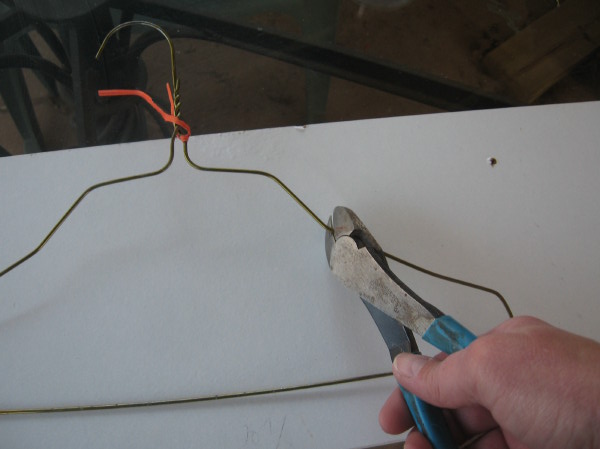
These are dykes.

No, not that kind.

The kind used to cut metal or wire........like wire coathangers.


Cut each side of the hanger at the shoulders.


Then cut the long bottom side exactly in half.


Leaving this. (Toss the hook part unless you have another creative use for it).


Here's the two ends, looking suspiciously like stakes, perfectly designed for holding down drip hose in any sort of garden: raised bed, tilled earth, lasagna or........wait for it.............straw bale!


One can never have too many stakes for hose.


And here they are serving their new purpose - just push them down over your hose every 2 feet or so.


Keeping staking those miles of drip hose, using T-connectors where necessary, and caps at the endpoints.

I love drip hose. To use the straight or T-connectors, just push the hose into the connector. Drip hose lasts season after season and can be re-configured every year when I change my mind as to which way my garden is laid out. At the end of the gardening season, I watch the stores and buy up whatever hose and connectors are put on sale, stashing it away till the next spring.


The yellow hose leading towards the camera is the main hose that connects to the yard spigot.

The eventual goal is to have a water barrel here in the corner of this end of the garden, but I'm not entirely sure that it will have enough water pressure to push water through the permeable drip hose. Either way, the spigot water remains a backup, with the water barrel being a main source for water buckets.


All that hose laid out and staked with the wirehanger stakes. Yes you can purchase "garden stakes" if you need them, but why spend your hardearned money if you have wire hangers around the house? They work for staking hose, black plastic, clear plastic tunnels for starting plants early, the list is endless.


Occasionally when the drip hoses are first connected and turned on, there are geysers in unexpected places (that's what that odd brown root is marking). Then the water is turned off and that section of hose is cut and a connector put in. Or sometimes it's mended with duct tape. Depending on what I have available. Duct tape works, but is not the most aesthetically pleasing.


If you're planting a straw bale garden, and have laid and staked your drip hose, the next step is to spread a layer of soil over the drip hose.


This afternoon I had enough garden dirt (not potting soil) to layer over the first U shape of the bales. This early in the spring, this is all I need to prepare at this time. On the left arm of the U will be the melting sugar snap peas; along the back of the U spinach will be planted, and on the right hand side of the U, cauliflower.


The peas (and later the beans) will do much better (no matter where they are planted) if this Granular Garden Soil Inoculant is used. After reading about it (and reading it was available in any garden supply store, which it wasn't) I eventually had to order it online from Planet Natural.

It's easy to apply and non-toxic. Make a furrow in the dirt, add the seed, then sprinkle in the inoculant. The can above is enough for 150 linear feet (cost is $8.95 plus shipping). No danger of an overdose - the legume roots love it. The idea behind it is that the bacteria (that's what it is -bacteria) clings to the plant roots, and pulls nitrogen out of the soil/air/straw/planting medium and making the roots thick and healthy.


Then comes the fun part: writing the name on the little copper sign. I love these old-fashioned copper markers, and I pick them up at Target every year, in that $1 section at the front of the store.


What I planted today: Melting Sugar Snap Peas, Cauliflower, and Spinach. All cold weather crops that will love to have the occasional chilly evening, and then the hot sunny afternoons.

And if there should be a late frost or light snow, they'll be okay with that too.

I won't, but they will.
Disclaimer: No coathanger manufacturer has supplied me with coat hangers free of charge, and all Planet Natural did was accept my order and ship it to me for their customary charge. I can't remember the last time I got anything free. Definitely not the packets of seeds. Paid full price for them. Sure hope they grow.

Saturday, March 13, 2010

Straw Bales R Us

The experiment begins.....


Today we brought home 18 straw bales, in two loads, and could easily use 18 more, but I'm baled out for the day.

The trick is to place them where you want them. Never plan on moving them 1) after they are wet at all; and 2) after they are planted. The first will break your back and the second will break your plants.

First I wasn't sure if they are meant to be planted sitting with the raw side up, or the flat compacted side. Ended up going with the flat compacted side. 50-50 chance that's wrong -I'll let you know.

Then I couldn't decide how to arrange them. Started with a long line, like outside walls. then realized the drip hose has to run along the top, and it would be more efficient not to have walk-through breaks. So currently they are set serpentine style. This may change.

Started looking for legume inoculant, which is harder to say outloud than you would think. i want to plant peas and beans in some of these bales, and the inoculant is a bacteria that gets sprinkled on the top to help the root systems convert nitrogen in oxygen into nitrogen for their roots. Kindof like making it out of thin air. This will eliminate the need for additional fertilizer.

Found it online, but am going to try one more local place on Monday to save the shipping cost if possible.

Also got the remainder of the plastic down - this will be a pepper bed I think - it's the lower side of the blueberry patch. Peppers love black plastic and the warmth it gives their roots.


Also got the plastic down next to the garage bed. Somehow I forgot to get the straw bales for this area. For the last several years, whatever I plant here (cukes, cauliflower, broccoli) have been eatten alive. Only in this bed though, making me think it's some insect that winters over in the soil, then pops up to find I've planted it a smorgasbord breakfast. Like the big garden, this small patch can bake over the summer, and kill whatever lives there. Meanwhile the straw bales will grow cukes galore.

A few volunteer onions are up -this bed needs revitalizing this year. I may just do plastic here and bales too -it's cool and shady even at the height of summer -might be a great place for lettuce.

Speaking of lettuce, I also ordered the shade cloth for the greenhouse this afternoon. It's cloudy, and low 60's today, but it's 100 degrees in the greenhouse. The shade cloth coming is 60% black woven meaning it should cut 60% of the UV and sun, so I can continue growing some crops in the greenhouse this summer.

The pot of comfrey is coming up. I want to plant a bed of this somewhere in the yard this year -this plant lasted until January, and provided leaves for the water bucket. Comfrey leaves in water makes a great fertilizer, plus it's a prime ingredient for comfrey salve.


The cauliflower plants are almost ready to set out.


In back of the cauliflower, the Sicilian Marjoram is coming back. I've decided to plant large amounts of marjoram, basil, oregano and sage this year to mix my own Italian seasoning.


My poor sad spinach seedlings. I seem to be incapable of growing this. Maybe if I buy larger plants....


Lettuce taking it's leisurely time to get big enough to eat. We may starve before this is large enough.


And of course there's still the whole rain barrel system to tweak this year, and the pond to add to the mix, and the drip hoses to lay......


Plus the more I look at those photos of the straw bales, the more I think I'm going to rearrange them. Perhaps a T-design.

Friday, March 5, 2010

This Year's Game Plan

This is the year we deal with the dreaded evil wiregrass.

As mentioned a few days ago, I'm pulling up all my tomato fencing, carpet paths and drip hoses just so I can rototill my lasagna-garden beds and rake out as much of the cut-up wiregrass as possible. Then, the entire garden, or almost all of it, will be covered with black plastic. The idea is to literally bake the soil and burn up the wiregrass in the soil.

Of course this will affect the rest of the healthy soil microbes, and mean I'll need to refresh the soil with manure, compost and everything else I can think of to bring it back to life - BUT- if I don't bake the soil, the wiregrass will just increase and choke out the desirable plants.

So my entire garden will be under black plastic this year but I still need to grow veggies.

The answer is straw bale gardening.

Photo from Nichols Garden Nursery

The idea is perfect not only for my situation but for anyone who wants to garden without digging, tilling, building raised beds, or doing much weeding.

Straw bales are available at most gardening centers, or at rural farms if you're lucky enough. At our Lowe's they cost approximately $4.00 each.

Clicking on the credits for either of these pictures will take you to two sites with much more detail. The basic idea works this way:

1) Set the dry bale whenever you want your garden to be. Water the bale for 10 days.

2) To plant seeds, spread a layer of compost, fertilizer, and potting soil over the top of the bail. Water. Plant the seed in this layer.

3) For seedlings, hollow out a planting hole, and fill it with compost, fertilizer, potting soil, and water again. Plant the seedling in said hole.

3) You must water everyday. I've seen a couple ideas, and the best is at the site below (Charlotte Nelson's) - the idea of laying the drip hose across the tops of a succession of bales. I'm planning on hooking up the drip hoses to my rain barrel system.

4) The top site, Nichols Garden Nursery, mentions I'll need something called legume inoculant for my peas and beans. I've no idea what this is, but as soon as I find it, I'll let you know.

This is the goal:

Photo from Charlotte Nelson's Straw Bale Garden

Pros would also include less chance of disease and soil insects finding the plants, easy to mow around, bales should last at least two years, and after they begin to fall apart and decompose, they can be used as mulch (on what will hopefully be my newly wiregrasss-free garden).

Plus, I'm thinking I can build mazes with the bales and provide instant entertainment for the neighborhood kids.